5 Best Hidden Object Games You've Never Played (But Should)
When Hidden Object Games Actually Tell Stories
I spent twenty minutes staring at a dusty library in a hidden object game last week, not because I couldn't find the magnifying glass, but because I was genuinely curious about what Howard had been reading before he disappeared. Most hidden object games dump random junk in cluttered rooms and call it a day. These five games get ignored despite having actual stories—not just random objects scattered behind furniture.
Instead of making you squint at tiny items hidden in impossible places, these games make you care about solving the mystery. Each one hooked me for different reasons, and none of them play the same way.
Antique Mysteries: Secrets of Howard's Mansion - The Psychological Deep Dive
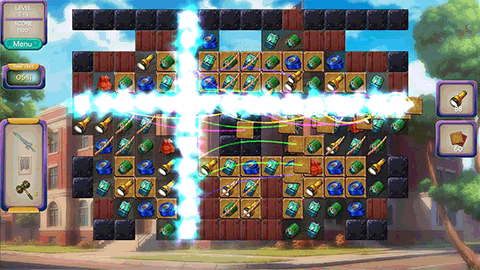
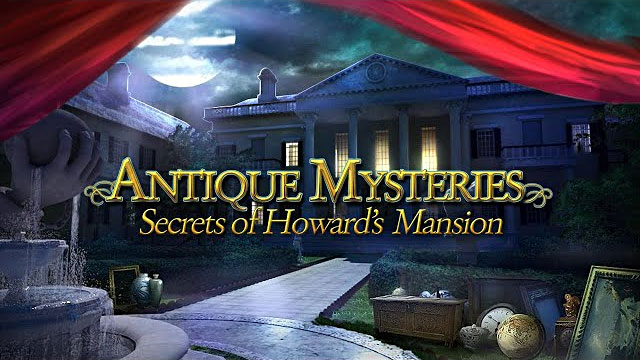
Howard collected antiques obsessively, and now he's missing. [Antique Mysteries: Secrets of Howard's Mansion](https://www.gamefools.com/pc-games/antique-mysteries-secrets-of-howards-mansion.html) turns his mansion into a character study disguised as a hidden object game.
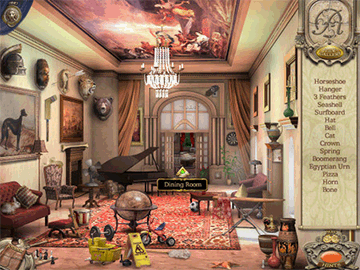
The genius move here is making every hidden object matter to Howard's story. You're not just finding random teacups—you're uncovering evidence of his mental state through the things he hoarded. A broken compass in his study. Love letters hidden in a music box. Each room reveals another layer of his obsession.
The pacing surprised me. Where most hidden object games rush you through scenes, this one lets you examine Howard's belongings at your own speed. I spent an hour in his bedroom alone, piecing together his relationship with his late wife through photographs and personal items.
The only friction comes from the mansion's layout—you'll backtrack through rooms frequently as new areas unlock. But that repetition actually works here, like returning to a crime scene with fresh eyes.
Perfect for players who want mystery over speed. Skip if you prefer action-packed gameplay.
Mysteries Mix: Echoes Between Worlds - The Reality-Bending Puzzler
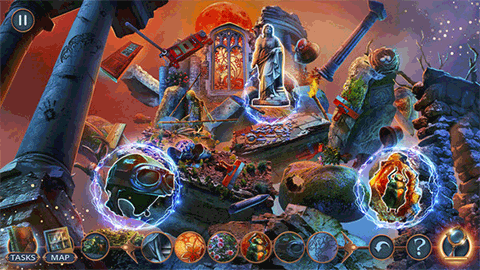
Dimensional rifts are tearing apart reality, and somehow you're the only one who can see the displaced objects. [Mysteries Mix: Echoes Between Worlds](https://www.gamefools.com/pc-games/mysteries-mix-echoes-between-worlds.html) uses this premise to justify the weirdest hidden object gameplay I've encountered.
Objects from different dimensions appear in the wrong places—medieval armor in a modern kitchen, alien technology in a Victorian parlor. The brilliant twist is making these displaced objects the actual clues to closing the rifts.
Each scene becomes a logic puzzle. Why is there a Roman coin in this space station? Because someone from that era got pulled through the rift. The hidden objects aren't random—they're evidence of dimensional bleeding.
The difficulty ramps up quickly. Early scenes give you obvious misplaced items, but later levels hide interdimensional artifacts in plain sight. I got stuck for thirty minutes trying to spot futuristic objects camouflaged among present-day items.
The story payoff makes the challenge worthwhile. Unlike games that string together unrelated scenes, every object you find builds toward understanding the dimensional crisis.
Try this if you like sci-fi concepts and don't mind thinking hard about what you're looking for. Avoid if you want straightforward object hunting.
Mystical Riddles: Behind Doll's Eyes - The Creepy Family Drama
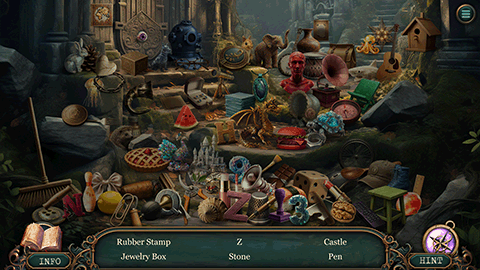
[Mystical Riddles: Behind Doll's Eyes](https://www.gamefools.com/pc-games/mystical-riddles-behind-dolls-eyes.html) starts with a family inheritance and quickly becomes the most unsettling hidden object game I've played. The family collects antique dolls, and something is very wrong with their collection.
What hooked me was how realistic the family dysfunction felt. These aren't cartoon villains—they're people whose grief over a lost child twisted into an unhealthy obsession with dolls. The hidden objects reflect this obsession: tiny doll shoes, miniature furniture, glass eyes scattered in unexpected places.
The searching becomes as obsessive as the family's doll collecting. You'll find yourself examining every porcelain face, wondering if it's hiding a clue. The game uses this psychological tension brilliantly—the longer you search, the more you understand the family's fixation.
The supernatural elements creep in slowly. At first, you're just investigating a strange inheritance. By the end, you're dealing with genuinely spooky phenomena that made me check over my shoulder while playing alone at night.
The learning curve takes a few scenes to click—the doll-themed objects can blend together visually. But once you attune to the game's logic, the searching becomes hypnotic.
Great for fans of psychological horror and family mysteries. Not recommended if dolls creep you out—this game will not help with that phobia.
Dark Town Secrets: Lost Lulu - The Pet Detective Story
A beloved dog named Lulu has vanished from a sprawling estate, and the family is falling apart. [Dark Town Secrets: Lost Lulu](https://www.gamefools.com/pc-games/dark-town-secrets-lost-lulu.html) could have been a simple missing pet story, but it evolves into something much more complex.
The estate feels lived-in rather than artificially cluttered. Dog toys scattered in logical places, leashes hanging where you'd expect them, food bowls that tell a story about Lulu's daily routine. The hidden objects connect to the investigation—you're not just finding random items, you're following Lulu's trail.
What surprised me was how the family dynamics emerge through the search. Different family members hid different objects, revealing their relationships with Lulu and each other. The teenage daughter's room contains hidden photos of Lulu that suggest a deeper bond than anyone realized.
The pacing works well for casual play. Each scene advances the investigation without overwhelming you with information. I found myself genuinely invested in finding Lulu, not just completing the game.
The estate's size can feel overwhelming initially—lots of rooms to explore and revisit. But the game guides you naturally through the investigation without holding your hand too much.
Perfect for players who want a heartwarming mystery without supernatural elements. Skip if you need darker, more intense themes to stay engaged.
Mind Echoes: Remnants of the Past - The Atmospheric Horror
Something sinister haunts the local park, and [Mind Echoes: Remnants of the Past](https://www.gamefools.com/pc-games/mind-echoes-remnants-of-the-past.html) makes you experience that presence through scattered memories and ghostly objects.
The park becomes a character itself. Playgrounds where children once laughed now feel ominous. Benches that should be peaceful hold dark secrets. The hidden objects aren't just things—they're fragments of traumatic memories that explain the haunting.
The atmosphere builds gradually. Early scenes feel melancholy rather than scary, but the tension accumulates as you uncover more disturbing remnants. By the midpoint, I was genuinely unsettled by what the objects revealed about the park's history.
The supernatural mechanics work cleverly here. Some objects only appear under certain conditions—shadows falling the right way, or when you've found related items first. This creates moments where the environment itself seems to be revealing its secrets.
The emotional weight can be heavy. This isn't jump-scare horror—it's the slow realization that terrible things happened in a place that should have been safe. The story doesn't pull punches about its dark themes.
Ideal for players who appreciate atmospheric horror and don't mind emotionally heavy content. Avoid if you prefer lighter mysteries or need frequent action to stay engaged.
Finding Your Match Among These Hidden Gems
These games split along clear lines. Antique Mysteries and Mystical Riddles reward patient investigation—you'll spend time studying scenes and piecing together psychological puzzles. Dark Town Secrets and Mind Echoes offer more straightforward progression with stronger emotional hooks. Mysteries Mix sits apart with its reality-bending concept that requires active problem-solving.
The pacing varies dramatically too. Mysteries Mix keeps you constantly thinking about dimensional logic. Dark Town Secrets lets you settle into a comfortable investigative rhythm. Mind Echoes builds dread slowly through environmental storytelling.
All five avoid the genre's biggest trap—hiding objects just to waste your time. Each game makes the searching feel purposeful, whether you're uncovering family secrets, following interdimensional clues, or piecing together tragic histories. Not flawless games, but memorable ones that remember why people loved hidden object mysteries in the first place.