Clutter 19: Survey Says What? Review - Chaos Never Felt So Satisfying

When Puzzle Chaos Actually Works
I almost bounced off Clutter 19: Survey Says What? within the first ten minutes. The screen exploded with hundreds of tiny objects—rubber ducks next to screwdrivers next to playing cards—all layered on top of each other like someone had dumped every junk drawer in your house onto one table. My eyes couldn't focus on anything specific. Then I spotted three identical blue stars buried in the mess, clicked them, and watched them vanish with a satisfying pop. Suddenly the chaos started making sense.
This nineteenth entry in the long-running Clutter series turns visual overwhelm into addictive gameplay. Where other puzzle games ease you in gently, Clutter 19 throws you into the deep end of pattern recognition and trusts you to swim. The result feels like digital archaeology—you're constantly excavating matching objects from layers of visual noise, and each successful dig delivers a small burst of dopamine.
The Core Loop: Controlled Chaos
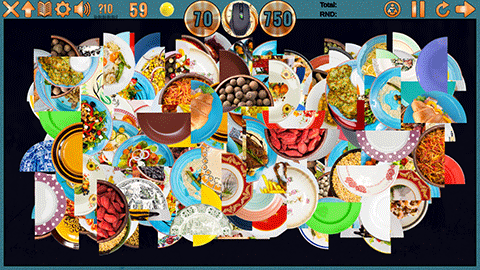
Every puzzle starts the same way: a screen packed with objects that seem randomly scattered but follow hidden rules. You scan for groups of identical items—three red triangles, four yellow circles, five green squares—then click to clear them. The twist comes in the variations. Diamond Style Clutter forces you to fill diamond-shaped gaps by rotating and positioning objects precisely. Rotation Matters adds a directional puzzle element where orientation becomes crucial. Pic Jong blends the familiar tile-matching of Mahjong with Clutter's signature visual density.
The most satisfying moments happen when you clear a large group and trigger a chain reaction. Objects slide down to fill empty spaces, creating new matches you hadn't seen before. It's like watching a Rube Goldberg machine built from pure pattern recognition. Box Quotes puzzles add wordplay to the mix—you're spelling out survey-style phrases by clearing letter-shaped objects, which sounds gimmicky but works surprisingly well when you're deep in the flow state.
Each cleared board takes five to fifteen minutes depending on complexity and your scanning speed. The game tracks your efficiency with star ratings, but the real hook is that moment when a seemingly impossible tangle of objects suddenly clicks into focus and you see the solution path.
Clutter 19: Survey Says What? Finds Its Rhythm
The learning curve hits different players in different ways. I struggled with the visual density for several levels before my brain adapted to the scanning pattern. Once it clicked, though, the game became almost meditative. Your eyes develop a rhythm—scan left to right, look for color patterns, check orientations, click and clear, repeat. It's like training your brain to see order in chaos.
The variety keeps sessions from feeling repetitive. Sliders add a tactile element where you're physically moving panels to reveal hidden matches. Square jigsaws interrupt the matching with traditional puzzle assembly. Pop-ups throw curveballs by adding dynamic elements that shift the board mid-solve. Each mode demands slightly different cognitive skills, so switching between them feels like cross-training for your pattern recognition muscles.
What surprised me most was how the game handles difficulty progression. Instead of gradually adding complexity, it throws you into challenging scenarios early and lets you develop skills through repetition. The Main Quest ramps up significantly around level 30, demanding both speed and strategic thinking as timers get tighter and object density increases.
Worth Noting: This Isn't Casual Gaming
Despite living in the casual puzzle category, Clutter 19 demands serious focus. The later levels require genuine concentration and patience. I found myself taking breaks after particularly dense sessions—not from boredom, but from mental fatigue. Your eyes need rest after scanning hundreds of tiny objects for extended periods.
The random level generation extends playtime considerably beyond the structured content, though the procedural puzzles sometimes lack the careful balance of the handcrafted ones. Some generated boards feel either too easy or frustratingly cluttered without clear solution paths.
The Verdict: Puzzle Veterans Will Love This
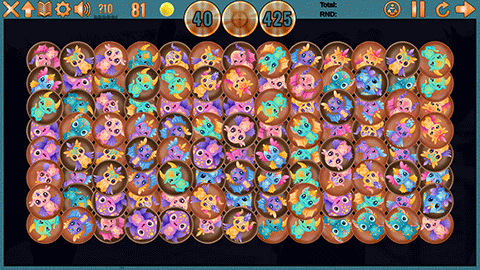
Clutter 19: Survey Says What? succeeds because it respects your intelligence while delivering consistent rewards for careful observation. This hits the sweet spot between casual match-three games and hardcore strategy puzzles. The visual chaos that initially seems overwhelming becomes the game's greatest strength—every cleared board feels like a genuine accomplishment because you've imposed order on genuine disorder.
Puzzle veterans looking for something meatier than typical matching games will find months of satisfying pattern recognition challenges here. The game trusts you to figure out complex spatial relationships while giving you that dopamine hit when matches clear perfectly. New players might find the learning curve steep, but persistence pays off with gameplay that feels uniquely engaging in the crowded puzzle space.
If you enjoy games that challenge your visual processing and reward methodical thinking, Clutter 19 delivers exactly what its chaotic screenshots promise. Just don't expect to master it quickly—this one earns its complexity honestly.
Ready to play? Download the free trial of Clutter 19: Survey Says What? and start playing today.