How to Master Virtual Villagers: A New Home

The Berry Counter Doesn't Lie, But It Also Doesn't Explain Itself
I quit here three times before I figured it out. Stared at my dying village, closed the window, convinced the game was busted. My food number kept dropping even though I had three people standing near berry bushes doing absolutely nothing productive. Turns out they weren't farmers yet. They were just villagers standing near food, looking at it, the way I look at a fridge at midnight without actually opening it.
That's the moment where you either learn to master Virtual Villagers: A New Home or you uninstall it and go play something with a health bar you can actually see draining in real time.
Five People, No Instructions, One Angry Volcano
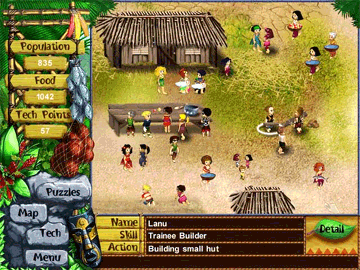
Five people show up on a beach. The tutorial says "drag villagers to things" and that's it. Good luck. Your tribe just survived a volcanic eruption and washed up on an island called Isola, and the game's opening move is to hand you total control and zero guidance about what any of it means. You drag a villager onto a berry bush. Nothing visibly happens for a while. You drag another one onto a broken well. Also nothing. You start to wonder if you're even playing the game correctly, or if this is some kind of elaborate screensaver that occasionally asks for input.
Thought this would be one of those games I could ignore for hours. Wrong. Ignore it for twenty minutes and your food supply craters, a villager gets sick, and someone starts a family without asking permission, which sounds charming until you realize that baby now eats as much as a grown adult and the mother is gone from your workforce for what feels like forever.
The Island Wants You Dead, Politely
Turns out the island wants you dead and you have to actually pay attention or your villagers just starve while staring at coconuts. Every system in this game quietly punishes neglect. Food drops if nobody's farming. Villagers get sick if nobody's trained in medicine. Curious islanders wander off toward glowing objects and puzzle triggers, and if you're not watching, they just stand there confused, wasting real-time minutes that you don't get back.
The real-time part is what throws people off first. This isn't a game you sit and click through start to finish. It runs whether you're watching or not, and villagers keep working, eating, aging, and occasionally having babies while you're off doing your taxes. Come back an hour later and the food count either climbed steadily or fell off a cliff, and there's no pause screen yelling at you about which one happened.
Skills, Trainees, and the Slow Grind to Competence
They get better at jobs the more they do them, like actual people, except way faster and they never complain about it. Drag someone onto farming repeatedly and eventually they level up from novice to trainee to master farmer, gathering food faster and more efficiently each tier. Same deal with building, science, and healing. The catch is you can't just eyeball who's good at what. You have to open the Details panel on each villager and actually check their skill levels, which I ignored for the first two hours because I assumed the game would just tell me. It doesn't. It waits for you to notice.
Once I started checking Details before assigning tasks, my whole village stopped feeling like a random shuffle of bodies and started feeling like an actual workforce. I had a farmer who was genuinely fast at gathering, a builder who kept upgrading structures without me babysitting him, and one guy who just wandered around being curious about rocks, which turned out to matter more than I expected.
Babies Are a Trap, Food Is Everything
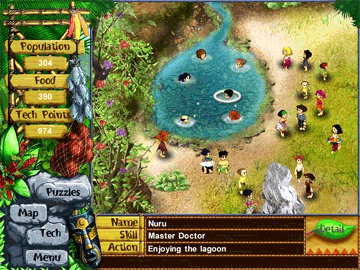
The biggest mistake I made early on was letting two couples pair off in the same week. Suddenly I had two babies, two mothers pulled from the workforce for roughly two years of in-game time, and a food supply that couldn't keep up with the extra mouths. Each baby eats like a full adult. Nobody warns you about this. You just watch your berry count nosedive and wonder why your thriving little society suddenly looks like it's rationing.
The fix, once I actually understood it, was boring but effective: keep food above 300 to 400 at all times before you even think about growing the population. Assign your strongest workers to farming first, always. Building and research can wait a little. Berries can't.
Tech Points and the Slow Unlock of Everything Interesting
Research is where the puzzle side of the game lives. Villagers assigned to science generate tech points over time, and you spend those points on upgrades that unlock new abilities, buildings, and areas of the island. Farming upgrades come first if you're smart, because better farming tech means more food per villager per trip, which solves the baby problem from a different angle instead of just telling people to stop having kids.
After every tech purchase, I got in the habit of dragging one adult around the island to poke at things. This is where the game's puzzle layer actually shows itself. New objects light up, villagers react with curiosity bubbles, and sometimes a whole new area opens up that was blocked before. Skip this step and you'll sit on unused tech points wondering why nothing new is happening, which was basically my entire second afternoon with the game before I figured out exploration wasn't optional flavor text.
Comparing the Pace to Other Casual Sims
Where a lot of time management games keep you clicking through tasks every few minutes, chasing a timer or a customer queue, Virtual Villagers: A New Home asks you to set priorities and walk away. The cognitive load is different too. You're not micromanaging individual clicks, you're doing macro planning: who farms, who builds, who explores, then checking back in periodically to redistribute labor. Your agency comes in bursts. You make a decision, the game runs on its own clock, and you return later to see the consequences and adjust. That gap between decision and outcome is the whole appeal if you like games that reward patience over reflexes, and the whole frustration if you're used to games where every second demands input.
Common Mistakes That Cost You Progress
Rushing population growth before food is stable will wreck your economy faster than almost anything else in the game. Ignoring the Details panel means you're assigning tasks blind, which wastes villager potential. Forgetting to explore after tech upgrades means puzzle progress stalls even though you technically have the tools to move forward. And leaving the game running unattended for long stretches without checking in can let sickness spread or let villagers idle uselessly near a job they're not even assigned to.
Saving before you experiment with a risky move, like reassigning your only skilled builder to research, gave me room to undo bad calls without losing hours of progress. That habit alone saved me from a few afternoons of frustration.
Quick Reference for Getting Started Right
Assign two or three villagers to farming immediately. Put one on building. Send the rest toward science once food looks stable. Check the Details panel before you assign anyone to anything. Don't let more than one couple start a family early on. Spend tech points on farming upgrades first. Drag an adult around the island after every upgrade to trigger new puzzle content. Keep food above 300 as a baseline safety net.
Who Should Actually Play This
If you liked the idea of a life sim but hated how much active clicking most of them demand, this is the version built for you. It rewards checking in a few times a day rather than sitting glued to the screen. If you need constant feedback and instant gratification, the slow real-time pacing will drive you up a wall, and that's a fair reason to skip it. But if you're the type who enjoys tending something quietly in the background of your day, coming back to see what your little tribe figured out without you, Virtual Villagers: A New Home earns its reputation as one of the more oddly addictive casual sims out there.
Ready to play? Download the free trial of Virtual Villagers: A New Home and start playing today.