Mirrors of Deception: The Price of Art Review
Mirrors of Deception: The Price of Art Review: A Museum Death That Doesn't Add Up
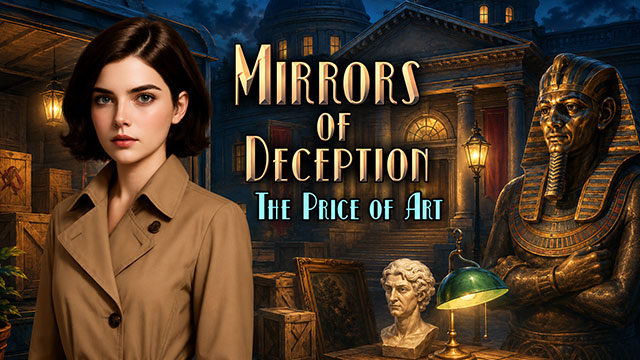
Agatha Hastings gets a phone call from her old mentor Professor Lionel Greaves, and by the time she reaches the Harrington Museum, he's already dead beside the painting he'd been hired to authenticate. The official line is an asthma attack. But the scattered notes on his desk and the way the canvas has been shifted from where it should be tell a different story before you've even picked up your first clue. That opening scene is where Mirrors of Deception: The Price of Art earns your attention, and it keeps earning it for the rest of the case.
This is a hidden-object puzzle adventure built around one question: who protected this painting badly enough to kill for it. You play as Agatha, picking up Greaves' unfinished investigation, and the museum stops being a building full of pretty things and starts feeling like a crime scene with a gift shop attached.
The Core Loop: Search, Solve, Interrogate, Repeat
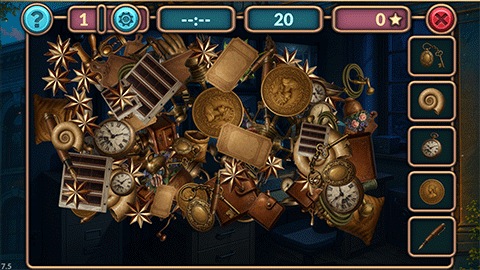
A typical scene works like this. You walk into a cluttered space - a storage room, a gallery office, an archive shelf nobody's dusted in years - and you're hunting for a specific list of objects buried in the mess. A magnifying glass tucked behind a stack of exhibition catalogs. A torn auction receipt half-hidden under a paperweight. Find everything, and the scene usually rewards you with an item or document that unlocks the next puzzle or the next conversation.
The puzzles themselves vary instead of repeating the same mechanic with new skins. One asks you to reassemble a shredded provenance document by matching torn edges. Another has you cross-referencing shipping crate numbers against a ledger to figure out which crate the painting actually arrived in versus which one the paperwork claims. These aren't padding between hidden-object scenes - they're how you build the case against whoever's been managing the museum's inventory a little too creatively.
Then there's the interrogation side, which is where the game separates itself from a lot of clutter-hunting mysteries. Suspects don't just recite a monologue and stand there. Question the museum's acquisitions director about the painting's paperwork, and her story shifts slightly depending on what you've already found. Show her a page from the shipping ledger that contradicts her timeline, and she backpedals into a different explanation entirely - one that raises more questions than it answers. That's the moment that sold me on this game: watching a suspect's composure crack because I'd found the one document she assumed nobody would dig up.
The Feel: Tense, Not Cozy
Some hidden-object mysteries let you drift through scenes half-paying attention, hunting for a rubber duck and a candlestick with no real stakes attached. The Price of Art doesn't let you relax that way. Every scene ties back to the murder, and the game paces its reveals so that each solved puzzle drops one new piece of information - a forged signature here, an overheard argument there - rather than saving every twist for a single overstuffed finale.
By the middle of the case, you start reading every suspect interaction differently. Someone who seemed like a minor character in the museum's org chart suddenly has a motive that makes uncomfortable sense once you've connected the ledger discrepancy to the shipping crate mix-up. I found myself replaying a conversation in my head between scenes, trying to figure out who had access to Greaves' office the night he died. That's a rare thing for this genre to pull off - most hidden-object mysteries treat their suspects as static portraits who deliver one speech and disappear. This one keeps circling back to the same handful of people and letting your evidence reshape what they're willing to admit.
Worth Noting
The opening hour asks you to hold a lot in your head at once - the museum's staff, the painting's ownership history, Greaves' notes, the timeline of the auction. If you're the type who wants to jump straight into puzzle-solving without absorbing backstory, give it a few scenes to click. Once the cast of suspects settles and you understand who benefits from the painting's murky paperwork, the case stops feeling like a lot of names and starts feeling like an actual investigation you're steering. The slower start is really the game trusting you to pay attention, and it pays off once the pieces start connecting.
The Verdict
Mirrors of Deception: The Price of Art succeeds because it treats its central mystery like an actual paper trail instead of an excuse to string together clutter scenes. The hidden-object hunting is well-constructed, the puzzle variety keeps individual scenes from blurring together, and the interrogation sequences give the story a spine that most games in this genre skip entirely. If you've worked through other museum or auction-house mysteries and found the suspects forgettable, this is the one where the accusations actually have to hold up against evidence you dug out of a filing cabinet yourself.
Play this if you want a hidden-object mystery where the clues change how people respond to you, not just what happens next in a cutscene. Skip it if you want something purely ambient to half-watch while doing something else - this one wants your attention on the details, and it's worth giving it.
Ready to play? Download the free trial of Mirrors of Deception: The Price of Art and start playing today.