Mystery Case Files: Huntsville Review - The Hidden Object Game That Started It All
The Game That Launched a Thousand Clones
For anyone who's ever found themselves squinting at cluttered computer screens looking for tiny objects, you can trace that obsession back to one game. Mystery Case Files: Huntsville arrived in 2005 and accidentally created an entire genre. Before Huntsville, hidden object games barely existed on PC. After it sold like crazy and spawned dozens of sequels, every casual game publisher wanted their own version.
What makes this origin story worth revisiting isn't nostalgia - it's how well the original formula still works. Strip away two decades of feature creep, minigame bloat, and complex storylines, and you get something surprisingly pure: just you, a messy room, and a list of things to find.
Detective Work, One Click at a Time
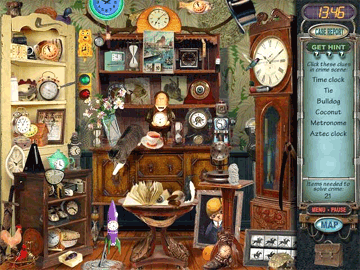
The Mystery Case Files: Huntsville gameplay loop couldn't be simpler. You're a rookie detective working cases around the fictional town of Huntsville. Each case sends you to 3-5 locations - a bookstore, cemetery, cafe, museum - where you hunt for specific items from a list. Find enough clues, head back to your Crime Computer, solve a tile-swapping puzzle, and boom - you've identified the criminal.
The magic happens in those cluttered scenes. You're looking for things like "hammer," "candy cane," or "paper clip" hidden among hundreds of objects. A red umbrella might be tucked behind a stack of books. A tiny key could be camouflaged against busy wallpaper patterns. The items are genuinely hidden but not unfairly so - they're the right size and color to blend in without being microscopic.
Each location gives you about 20 minutes to find your targets, with three hints available if you get stuck. Misclick on the wrong object and you lose precious seconds. The pressure builds as that timer counts down, especially when you're down to your last item and scanning desperately.
The Crime Computer Breakthrough
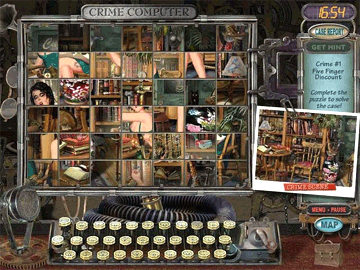
Once you've collected enough evidence, the Crime Computer puzzle kicks in. You're presented with scrambled tiles that form a picture of your suspect when arranged correctly. Click highlighted tiles to swap positions until the criminal's face emerges. It sounds basic, but there's something satisfying about watching that pixelated villain appear piece by piece - like developing a photo in reverse.
The criminals themselves are wonderfully absurd. You'll chase down Lars Larsen (a thief with a thing for stealing random junk), track grave robbers, and eventually uncover the criminal organization S.T.A.I.N. led by the unlikely mastermind Gertrude Goodlittle. The cases get progressively weirder - one involves someone turning cats into stuffed clocks, which sounds disturbing but plays out with cartoon logic.
Why the Formula Works
Huntsville succeeds because it respects your pattern-recognition skills without insulting your intelligence. Items are hidden using color, shape, and positioning tricks that feel clever rather than cheap. A brown boot might sit among brown books on a shelf. A white dove could perch against white curtains. You're not hunting for single pixels or impossibly tiny objects - everything is findable if you look carefully.
The randomization keeps things fresh too. Fail a case and restart, and you'll find different items in different locations. That bookstore that stumped you before might now hide a completely different set of objects. It's not just replaying the same puzzle - it's tackling a remixed version.
The progression feels earned. You start as a lowly Flatfoot and work your way up through ranks like Snoop and Gumshoe toward Master Detective. Each promotion comes after solving a case, giving you a sense of career advancement that's missing from most casual games.
The Art Holds Up Surprisingly Well
For a game from 2005, the visuals remain charming. Each location has personality - the bookstore feels lived-in with its crooked shelves and scattered papers, while the cemetery manages to be spooky without being genuinely creepy. The art style hits that sweet spot between detailed enough to hide objects effectively and clean enough that you're not fighting visual noise.
The music deserves mention too. Each location has its own atmospheric soundtrack that builds tension without being distracting. The bookstore gets quiet, scholarly tones while the cemetery goes full gothic. It's subtle work that keeps you immersed without calling attention to itself.
Where Time Becomes the Enemy
The one element that might frustrate modern players is the time pressure. Every case runs on a countdown, and failure means starting over completely. Most cases give you plenty of breathing room, but the final challenge restricts you to just 4 minutes to find 8 items plus solve the Crime Computer puzzle. It's genuinely stressful - the kind of white-knuckle finish that either thrills you or sends you looking for a more relaxed game.
The hit detection can be finicky too. Sometimes you'll click directly on an object and nothing happens, forcing you to try slightly different spots while your timer ticks away. It's not game-breaking, but it adds unnecessary friction to what should be smooth gameplay.
The Historical Context Matters
Playing Mystery Case Files: Huntsville today feels like discovering an important fossil. This is patient zero for an entire genre - the game that proved people would pay money to hunt for virtual objects in cluttered rooms. Before Huntsville, that concept sounded ridiculous. After it became a hit, everyone wanted to copy the formula.
What's remarkable is how pure the original vision remains. No inventory puzzles, no adventure game logic, no complex character relationships. Just observation skills, pattern recognition, and the satisfaction of solving cases through careful searching. Later entries in the series added minigames, complex storylines, and supernatural elements, but they never quite recaptured this focused simplicity.
The Verdict on a Genre Pioneer
Mystery Case Files: Huntsville isn't perfect - it's short, occasionally frustrating, and some of its content feels dated. But it nails the core hidden object experience better than most games that came after. If you enjoy spotting tiny details and don't need elaborate stories or complex mechanics, Huntsville delivers that focused treasure hunt feeling that launched a thousand imitators.
The game takes about 3-4 hours to complete, making it perfect for a weekend afternoon or a few evening sessions. You'll walk away understanding exactly why this simple concept exploded into a major casual gaming genre. Sometimes the best ideas are the ones that seem obvious in retrospect - and Huntsville's genius was recognizing that people love finding things that are hiding in plain sight.
Ready to play? Download the free trial of Mystery Case Files: Huntsville and start playing today.