Old PC Games from the 2000s You Can Still Play Today
Your Windows 11 machine can run games from 2004 better than the computers they were designed for. I discovered this last month when I installed Diner Dash on a whim and lost three hours serving pixelated customers. These old PC games from the 2000s don't feel outdated—they feel focused.
The 2000s produced a specific breed of PC game: lightweight, addictive, and built around one core mechanic done extremely well. No sprawling skill trees or daily login rewards. Just you, a mouse, and the kind of "one more level" compulsion that hits at midnight.
Action-Packed Shooters That Still Deliver
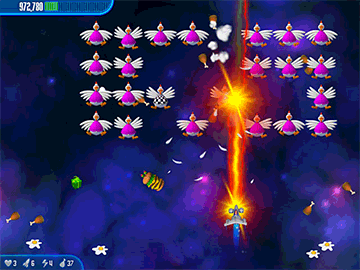
Chicken Invaders: Revenge of the Yolk sounds ridiculous until you're dodging drumsticks at 200 miles per hour. This space shooter throws waves of militant poultry at you while you collect power-ups and coins. The collision detection feels tight, the difficulty ramps smoothly, and destroying an entire formation of chickens with one well-timed laser blast never gets old.
Your ship moves exactly where you point it, no lag or drift. Each wave introduces new enemy patterns—dive-bombing roosters, egg-dropping hens, massive boss chickens that fill half the screen. The learning curve takes maybe three levels, then you're locked in for hours.
Feeding Frenzy flips the script entirely. Instead of shooting things, you eat them. Start as a tiny fish, consume anything smaller than you, grow larger, repeat. The tension comes from those split-second decisions: chase that school of small fish or avoid the predator lurking nearby?
The underwater environments shift from bright coral reefs to deep ocean trenches. Each level demands different strategies—some reward aggressive feeding, others punish reckless behavior. You'll spend twenty minutes as a cautious angelfish, then suddenly you're a massive shark clearing entire screens.
Time Management Games That Hook You
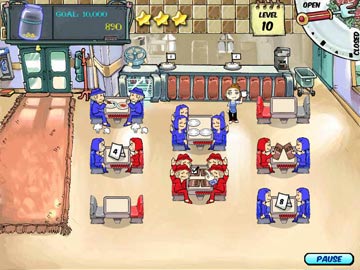
Diner Dash turned restaurant service into an art form. Flo moves between tables, takes orders, serves food, and cleans up while customers tap their feet impatiently. Each customer type has different patience levels and preferences—elderly couples tip well but move slowly, business people want speed, families with kids create chaos.
The genius lies in the chain combos. Serve four tables of the same color in sequence for bonus points. Clear all dirty tables at once for a cleaning bonus. The game rewards planning three moves ahead while managing immediate crises. One impatient customer can trigger a chain reaction that destroys your entire rhythm.
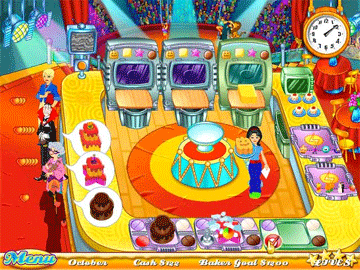
Cake Mania follows the same formula but adds baking complexity. Jill must mix batter, bake cakes, add frosting, and serve customers before they storm out. Different cake types require different oven times. Wedding cakes need multiple layers. Birthday cakes need specific decorations.
The pressure builds as orders pile up. You'll have three cakes baking, two customers waiting, and a wedding cake that needs assembly—all while the timer counts down. Success requires memorizing every recipe and optimizing every movement.
Match-Three Puzzles with Personality
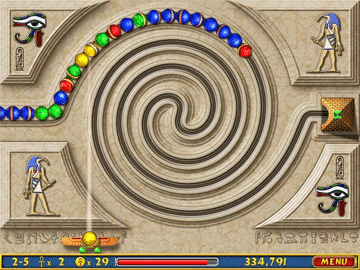
Luxor shoots colored spheres into a moving chain before it reaches the pyramid. Match three colors to eliminate them. Sounds simple until the chain moves faster and power-ups start flying everywhere.
The Egyptian theme isn't just decoration—each level represents a different tomb or temple, complete with hieroglyphic backgrounds and mystical sound effects. Power-ups like lightning bolts and fireballs can clear huge sections, but timing them wrong wastes precious shots. The difficulty spikes around level 15 when chains start moving at breakneck speed.
Jewel Quest takes match-three into adventure territory. Professor Pack searches Mayan ruins for artifacts by solving gem puzzles. Each successful match turns the background tile gold. Turn every tile gold to complete the level.
The twist: you can't just match anywhere. Strategic planning becomes crucial as available matches dwindle. Some levels require specific sequences to reach corner tiles. Others hide key gems under stone blocks that only certain matches can break.
Building and Strategy Games
Build-a-lot lets you flip houses for profit across different neighborhoods. Buy land, construct homes, upgrade them with amenities, then sell for maximum return. Each neighborhood has different property values and buyer preferences.
The economic simulation runs deeper than expected. Building too many luxury homes floods the market and drops prices. Ignoring basic homes means missing steady income. Weather events can damage properties. City inspectors demand specific building codes. Balancing all these factors while racing against level timers creates genuine strategic tension.
Farm Frenzy drops you into agricultural chaos. Scarlett raises chickens, collects eggs, processes them into products, and ships everything to market. Bears occasionally raid your farm, requiring guard dogs for protection.
The production chains grow complex quickly. Eggs become egg powder. Milk becomes cheese. Cheese becomes cake. Each processing step takes time, and trucks arrive on schedules you can't control. Managing five production lines while fending off predators and upgrading equipment demands constant attention.
Life Simulation and Virtual Pets
Virtual Villagers: A New Home runs in real-time, even when you're not playing. Your tribe of castaways slowly builds civilization on a mysterious island. Villagers age, have children, develop skills, and die of old age over several days of real time.
The pacing feels meditative compared to other games. Check in morning and evening to assign tasks, solve puzzles, and guide research. Villagers work independently, but major decisions require your input. Should you focus on food production or technology? Train more builders or researchers?
Discovery drives long-term engagement. The island holds secrets that take weeks to uncover. Ancient ruins hide advanced technologies. Strange plants provide magical effects. Each puzzle solution reveals new mysteries.
Fish Tycoon and Plant Tycoon both use genetic breeding as core gameplay. Fish Tycoon challenges you to discover seven magic fish species through selective breeding. Plant Tycoon focuses on finding six magic plants through cross-pollination.
Both games reward patience and experimentation. Breeding takes real-time hours. Failed experiments cost money and time. Success requires careful record-keeping and strategic planning. The magic species command premium prices, but finding them requires breeding hundreds of common varieties first.
Classic Arcade Action
Ricochet Lost Worlds reinvents brick-breaking with 3D environments and physics-based power-ups. Your paddle controls a ball that bounces around elaborate levels, destroying blocks and collecting items.
The "lost worlds" theme shows in the level design—ancient temples, space stations, underwater caverns. Each environment introduces new block types and obstacles. Some blocks require multiple hits. Others explode and damage nearby blocks. Power-ups like multi-ball and laser paddle change strategies completely.
The physics feel satisfying in a way that flat Breakout clones can't match. Balls curve around obstacles, ricochet off angled surfaces, and build momentum through complex bounces. Mastering the physics becomes as important as quick reflexes.
Why These Games Still Work
These 2000s titles share common strengths that many modern games abandon. They load instantly—no patches, no login screens, no mandatory tutorials. The learning curves peak within minutes, not hours. Each game focuses on one core mechanic instead of trying to be everything.
They were built for mouse and keyboard, so the controls feel natural on modern PCs. No awkward console-to-PC ports or touch-screen compromises. Click where you want to go, drag to select, right-click for context menus.
The graphics may look dated, but the gameplay holds up because good mechanics don't age. Matching three gems feels the same in 2024 as it did in 2004. Managing restaurant tables requires the same skills. Breeding virtual fish rewards the same patience.
Got five minutes? Try Luxor. Have an hour? Start a Virtual Villagers colony. Want to zone out completely? Diner Dash still hits different. These aren't museum pieces—they're games that happen to be twenty years old but remain surprisingly addictive.