Games Like Mortimer Beckett: Hidden Object Adventures That Make You Build
When Finding Pieces Beats Finding Objects
Most hidden object games hand you a shopping list. Find the hammer. Click the key. Spot the magnifying glass. But games like Mortimer Beckett flip this completely - instead of hunting for whole objects, you're scrounging for fragments of a wrench handle, three pieces of a telescope lens, and the missing gears from a pocket watch.
This changes everything about how you search. Your eyes scan differently when you know that shiny thing in the corner might be one-third of something useful rather than a complete tool. You start noticing curves that could connect, metal pieces that look purposefully broken, and wooden fragments that seem designed to fit together.
The two main games that perfected this fragment-hunting approach are Mortimer Beckett and the Secrets of Spooky Manor and Mortimer Beckett and the Time Paradox. Both games turn you into a scavenger who builds tools from scratch instead of just finding them whole.
Spooky Manor: Where It All Started
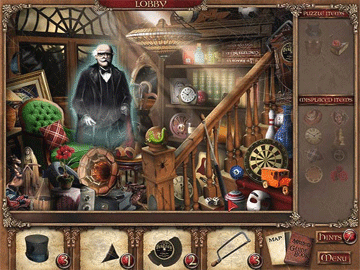
The first Mortimer Beckett game drops you into your uncle's mansion with one goal: find the scattered pieces of his mysterious Ghost Machine and put them back together. But nothing in this house exists as complete objects anymore. The screwdriver you need? Its handle is behind a painting, the metal shaft is tucked under a chair cushion, and the tip is somehow wedged inside a grandfather clock.
Each room becomes a forensic investigation. You're not just clicking on obvious items - you're hunting for fragments that could belong to anything. That copper-colored sliver near the fireplace might be part of a key, or maybe it's a piece of the ornate picture frame you're supposed to assemble three rooms later.
The mansion itself feels like it was designed by someone who took apart every useful object and hid the pieces as a cruel joke. Kitchen utensils are scattered across bedrooms. Clock parts end up in the library. The front door key somehow got broken into four pieces and distributed throughout the entire first floor.
What hooks you is the moment when fragments finally click together in your inventory. You've been carrying around mysterious metal pieces for twenty minutes, and suddenly they snap into a complete wrench that opens the basement door. That satisfaction hits differently than just finding a wrench sitting on a table.
The game moves at a crawl, but that's the point. You spend several minutes per room, methodically checking every corner twice because you know there are still two pieces of that important gadget hiding somewhere. Some players bounce off this pacing - it's nothing like the rapid-fire clicking of typical hidden object games.
Time Paradox: Fragment Hunting Across History
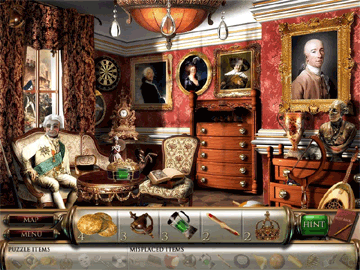
Mortimer Beckett and the Time Paradox takes the same fragment-building concept but scatters the pieces across different time periods. Now you're not just searching one spooky mansion - you're jumping between ancient Egypt, medieval castles, and futuristic laboratories, all while hunting for pieces of time-travel equipment that got scattered across history.
The time-hopping creates a different kind of search anxiety. In Spooky Manor, you knew that missing gear was probably somewhere else in the house. Here, the third piece of your time compass might be in a Roman colosseum while you're stuck searching a Wild West saloon. You can't just backtrack to the previous room - you have to solve the current era's puzzles to unlock the next time portal.
Each historical period has its own visual style, which makes fragment-hunting both easier and harder. Egyptian levels hide golden pieces among hieroglyphs and sandstone, while medieval scenes blend metal fragments into suits of armor and weapon racks. Your brain works differently when you're hunting fragments across these varied backdrops instead of just one consistent mansion interior.
The time pressure adds urgency that the first game lacked. Spooky Manor let you poke around the mansion forever, but Time Paradox keeps reminding you that reality is unraveling and you need to close the time portal before everything collapses. This creates a weird tension - you want to search thoroughly for every fragment, but the story keeps pushing you to hurry up.
How Fragment-Hunting Changes Your Brain
Playing these games rewires how you approach hidden object scenes. In traditional games, you're looking for complete, recognizable shapes. A teapot looks like a teapot. A pair of scissors has two obvious blades and handles.
But Mortimer Beckett games train you to see potential instead of completed objects. That curved piece of metal could be part of a key, a gear, or the handle of some Victorian gadget you haven't even imagined yet. You start noticing textures and materials instead of shapes - wood grain that suggests furniture parts, metallic glints that hint at mechanical components.
The assembly process becomes just as important as the searching. Your inventory fills up with mysterious fragments, and part of the puzzle is figuring out which pieces belong together. Sometimes you'll carry around a wooden handle for three rooms before finding the metal piece that completes it into a useful tool.
This creates more involvement in the process than just clicking on finished objects. When you finally assemble that complicated clockwork device from seven different fragments you found scattered across the mansion, you feel like you actually built something instead of just picking it up.
The Pacing Problem That Some Players Love
Both games crawl compared to modern hidden object titles. Where newer games might have you clicking through dozens of objects per minute, Mortimer Beckett games expect you to spend five or ten minutes per screen, carefully examining every corner for tiny fragments.
This slow pace frustrates players who want quick dopamine hits from rapid clicking. But it hooks players who enjoy methodical searching and the satisfaction of gradual progress. You're not just clearing screens - you're slowly building up an inventory of useful tools that will eventually solve bigger puzzles.
The fragment system also means you can't just randomly click until you find everything. You need to actually look at what you're collecting and think about how pieces might fit together. A gear without teeth probably connects to a different mechanism than a smooth gear. A wooden handle with metal fittings suggests a different kind of tool than one with rope wrapping.
Comparing Fragment Games to Traditional Hidden Object Games
Standard hidden object games give you a list and turn searching into a matching exercise. You see "find the hammer" and scan the scene until you spot something hammer-shaped. The challenge is purely visual recognition.
Mortimer Beckett games make you work backwards from incomplete information. You find a metal rod and have to guess what it might become when combined with other fragments. This shifts the challenge from recognition to imagination and logical assembly.
The time investment differs too. Traditional hidden object games let you complete scenes in two or three minutes if you're efficient. Fragment games demand longer attention spans because you're not just finding objects - you're building them, testing combinations, and figuring out how your assembled tools solve environmental puzzles.
Your sense of progress changes as well. In list-based games, each found object immediately reduces your remaining tasks. In fragment games, finding pieces actually increases your workload temporarily because now you have more inventory items to manage and combine. The payoff comes later when fragments suddenly click together into something useful.
Who Should Play Fragment-Based Hidden Object Games
These games work best for players who enjoy slow, methodical puzzle-solving over quick reflexes. If you like taking apart mechanical devices to see how they work, or if you enjoy jigsaw puzzles where you study piece shapes before placing them, the fragment-hunting approach will feel natural.
They're also good for players who get frustrated with traditional hidden object games because the items feel arbitrary. When you're building tools from fragments, every piece you find has a clear purpose, even if you don't know what it is yet.
Skip these if you prefer fast-paced gaming or get impatient with inventory management. The fragment system creates a lot of clicking back and forth between your inventory and the game world, and some players find this tedious rather than engaging.
Both Spooky Manor and Time Paradox offer the same core fragment-hunting experience, but Time Paradox adds variety through its historical settings while Spooky Manor provides a more focused, atmospheric experience in one location. Either one will show you whether this style of hidden object gaming clicks with how your brain likes to solve puzzles.