Games Like Mystery Case Files: Ravenhearst That Actually Challenge You

When Hidden Object Games Stop Being Casual
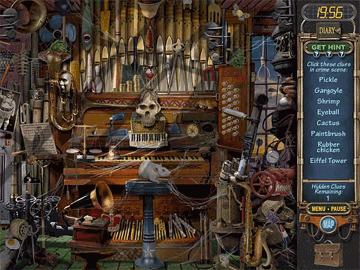
You click through your seventeenth brass key search in what feels like the same dusty library, and suddenly realize you've been playing for twenty minutes without thinking. Most hidden object games let you cruise on autopilot, but Mystery Case Files: Ravenhearst refuses to let your brain coast. The moment you think you've figured out the pattern, it throws a door mechanism that requires actual problem-solving instead of just clicking on sparkly objects.
That's what makes Ravenhearst different from the flood of casual hidden object games. It doesn't just hide a boot behind a curtain—it makes you understand how that boot opens a clockwork puzzle that reveals the next story fragment. The game respects your intelligence enough to make you work for progress.
Why Ravenhearst's Puzzles Actually Matter
Most hidden object games treat puzzles like speed bumps between item hunts. Find twelve candles, get a brief sliding tile puzzle, move to the next room. Ravenhearst flips this completely. The elaborate door mechanisms become the main event, with hidden object scenes serving as preparation for the real challenges.
These aren't your typical "match three gems" mini-games. The door puzzles work like Rube Goldberg machines—pull this lever to rotate that gear, which drops a ball that triggers the next mechanism. You spend genuine time figuring out the sequence, not just clicking randomly until something works. When you finally hear all the gears click into place and watch the door swing open, you earned that moment.
The mansion setting amplifies this feeling. Each room you unlock feels like a genuine discovery rather than just the next level. The game builds tension by making you question whether you're solving puzzles or if something in Ravenhearst is solving you. Story fragments scattered through diary pages and environmental details create an investigation that requires actual attention, not just inventory management.
Games Like Mystery Case Files Ravenhearst for Puzzle Lovers
If Ravenhearst's mechanical puzzles hooked you, other games scratch similar itches but with different approaches to challenge and atmosphere.
The Room series takes the intricate mechanism concept and makes it the entire game. Where Ravenhearst alternates between hidden objects and door puzzles, The Room games are pure mechanical puzzle boxes. You manipulate ornate contraptions with dozens of moving parts, using tools and keys to unlock increasingly complex chambers. The tactile feedback when gears mesh and locks click open rivals Ravenhearst's most satisfying moments, but without any hidden object hunting to break the flow.
Rusty Lake Hotel offers the same "something sinister is happening" atmosphere but wraps it in point-and-click adventure mechanics. Instead of searching for hidden thimbles, you solve environmental puzzles that reveal disturbing story details about each hotel guest. The puzzles require lateral thinking—combine seemingly unrelated items to create solutions that make perfect sense in hindsight. Like Ravenhearst, it rewards players who pay attention to environmental storytelling rather than rushing through scenes.
For players who want more hidden object content but with Ravenhearst's puzzle complexity, Mystery Case Files: Return to Ravenhearst delivers exactly that. It expands the manor to over 150 scenes while maintaining the original's focus on mechanical door puzzles and narrative investigation. The sequel adds more adventure-style exploration, letting you move between rooms more freely rather than following a linear progression. This creates more opportunities for backtracking with new tools, similar to how Metroidvania games gate progress behind ability upgrades.
What Makes These Games Work (And When They Don't)
Ravenhearst succeeds because it commits fully to being a puzzle game that happens to include hidden objects, not the reverse. The mechanical door locks demand genuine problem-solving skills. You can't brute-force your way through by clicking everything on screen—you need to understand how each component connects to the others.
This creates a specific type of player satisfaction that casual hidden object games rarely achieve. Instead of the mild dopamine hit from finding a cleverly hidden shoe, you get the deeper reward of solving an actual mechanical problem. Your brain has to work, which makes success feel earned rather than inevitable.
But this approach also creates friction that turns off players expecting pure casual entertainment. Some puzzles require multiple attempts to understand the underlying logic, especially the more complex door mechanisms. Players who just want to relax and hunt for hidden objects might bounce off when confronted with a lock that demands fifteen minutes of careful experimentation.
The game also front-loads its difficulty in ways that can frustrate newcomers. Early puzzles establish patterns that later mechanisms subvert, so players who expect consistent rules throughout might feel blindsided when familiar strategies stop working. This isn't necessarily bad design, but it does mean Ravenhearst rewards persistence over casual play.
Comparing Pacing and Player Investment
Where typical hidden object games let you zone out and click through scenes at whatever pace feels comfortable, Ravenhearst demands active engagement. You can't just scan for highlighted objects—you need to understand how items connect to environmental puzzles and story progression. This creates a completely different relationship with the game.
The cognitive load shifts from pattern recognition (spotting hidden items) to systems thinking (understanding how puzzle components interact). Instead of the meditative flow of scanning illustrated scenes, you're constantly evaluating cause-and-effect relationships between mechanical elements. This makes Ravenhearst feel more like an adventure game that includes hidden object elements rather than a hidden object game with occasional puzzles.
Player agency changes dramatically too. Most hidden object games give you a list and let you find items in whatever order feels natural. Ravenhearst's mechanical puzzles have specific solution paths—you can't just click randomly and expect progress. This creates higher stakes for each interaction, since wrong moves might require resetting complex sequences.
The time investment reflects these differences. A typical hidden object scene might take three to five minutes of relaxed searching. Ravenhearst's door puzzles can easily consume twenty minutes of focused problem-solving, especially if you're working through the logic without hints. Players need to budget mental energy differently, treating sessions more like puzzle-solving workshops than casual entertainment.
Who Should Play Ravenhearst (And Who Should Skip It)
Pick Ravenhearst if you've ever found yourself bored by hidden object games that feel too easy, or if you enjoyed escape room games and want something with better production values. The mechanical puzzles provide genuine intellectual challenge without requiring twitch reflexes or memorizing complex control schemes. Players who appreciate clockwork mechanisms, antique contraptions, or steampunk aesthetics will find the door puzzles especially satisfying.
Skip it if you use hidden object games primarily for relaxation or stress relief. Ravenhearst's puzzles create tension rather than releasing it, and some mechanisms require multiple failed attempts before the solution becomes clear. Players who prefer games they can play while watching TV or listening to podcasts will find the puzzle complexity disruptive rather than engaging.
The sweet spot is players who want their casual games to include actual challenges but don't want the time pressure or competitive elements of action games. Ravenhearst lets you think through problems at your own pace while still requiring genuine mental effort to progress. It's perfect for quiet evenings when you want to engage your brain without dealing with online multiplayer stress or complex strategy game mechanics.