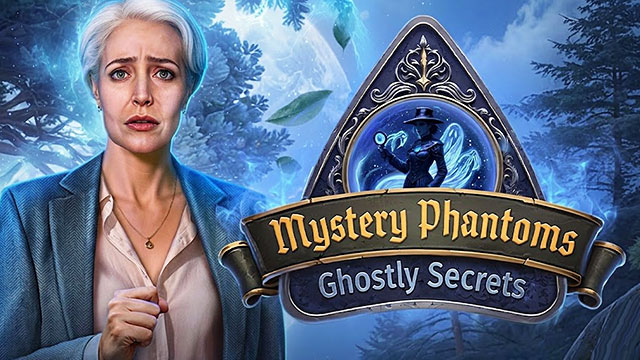
Mystery Phantoms: Ghostly Secrets Review - Supernatural Investigation That Doesn't Insult Your Intelligence
For Hidden Object Fans Who Crave Real Mystery
You know that moment in most hidden object games where the "mystery" becomes painfully obvious after the first scene? Mystery Phantoms: Ghostly Secrets skips that entirely. Playing as investigator Riley Morto, I found myself genuinely puzzled by what happened in these haunted locations—not because the game withholds information, but because it trusts you to piece together evidence like an actual detective.
The game throws you into four distinct hauntings: a mansion library where books seem to rearrange themselves, a motel parking lot filled with abandoned cars, a hospital ICU that conducted questionable experiments, and a school courtyard where students saw something they shouldn't have. Each location feels like stepping into a crime scene that's been contaminated by supernatural forces.
The Investigation Loop That Actually Works
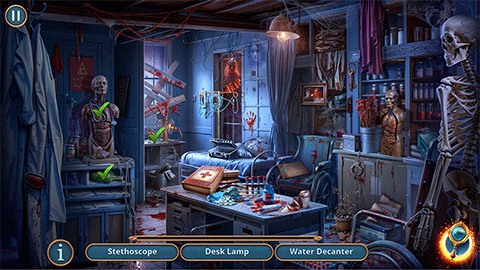
Here's your typical 20-minute session: Enter a new area, scan for obvious hidden objects first, then start noticing the weird details. In the mansion library, I spent five minutes just trying to understand why certain books were pulled from the shelves in a specific pattern. The game doesn't highlight these clues—you have to notice that the scattered volumes spell out a message when viewed from the right angle.
The hidden object scenes blend seamlessly with puzzle-solving. You're not just collecting random items to fill a list. Every object you find serves the investigation. That bloody scalpel from the hospital ICU? It becomes crucial evidence when you discover the surgical notes hidden behind a loose tile. The car keys from the motel? They unlock a trunk containing a journal that rewrites everything you thought you knew about the case.
Mini-games appear when you need to restore damaged evidence or reconstruct crime scenes. I particularly enjoyed a sequence where you have to rebuild a shattered ritual circle using fragments found throughout the asylum. The game gives you enough context clues to solve it logically, but you still feel clever when the pieces click into place.
Atmosphere That Creeps Under Your Skin
This game understands that effective horror comes from suggestion, not jump scares. The mansion library feels wrong because books keep appearing in places you've already searched. The motel parking lot unsettles you with its complete silence—no wind, no distant traffic, just the sound of your footsteps on cracked asphalt.
The visual design supports this perfectly. Each location looks lived-in before it became haunted. The hospital ICU still has patient charts on clipboards, but the handwriting grows increasingly erratic toward the bottom of each page. The school courtyard has normal playground equipment, except the swings move slightly even when there's no breeze.
Sound design deserves special mention. Ghostly whispers drift through your headphones just loud enough to notice but too quiet to understand. I caught myself turning up the volume and leaning closer to my screen, which is exactly what the game wants. The audio cues often hint at hidden object locations—a faint scratching sound led me to discover a hidden compartment behind a hospital bed.
Investigation Mechanics That Respect Your Time
The journal system becomes your best friend. Every clue you discover gets automatically categorized and cross-referenced with other evidence. When I found a patient ID number in the hospital, the game immediately highlighted related documents I'd collected from other locations. This prevents the frustrating backtracking that plagues many hidden object games.
Hint systems work intelligently. Instead of just highlighting random objects, hints point toward logical next steps in your investigation. If you're stuck in the motel parking lot, a hint might suggest examining the car with out-of-state plates rather than just showing you where the hidden wrench is located.
The difficulty curve feels carefully calibrated. Early scenes teach you the game's visual language—how shadows indicate interactive areas, how certain textures suggest hidden compartments. By the time you reach the more complex hospital sequences, you're reading the environments like an experienced investigator.
Four Distinct Hauntings, Four Different Challenges
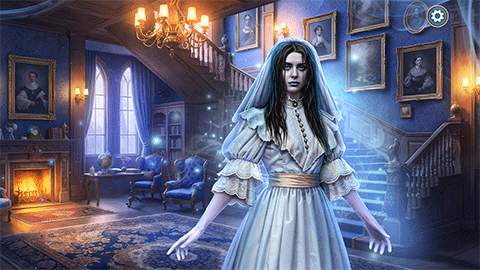
Each location presents unique investigation challenges. The mansion library requires careful observation and pattern recognition. Books serve as both hidden objects and clues to a larger puzzle about the family's dark history. I spent nearly an hour in this location, not because it was difficult, but because every bookshelf revealed new layers of the mystery.
The motel parking lot focuses on forensic-style evidence gathering. You're essentially conducting a missing persons investigation using only the belongings left in abandoned vehicles. Each car tells a different story, and the challenge lies in connecting these individual narratives into a coherent timeline.
Ravenhill Hospital ICU shifts into psychological horror territory. The hidden objects here often relate to medical equipment and patient records, but the real puzzle involves understanding what experimental treatments were conducted and why they went wrong. The game doesn't shy away from darker themes, but handles them with appropriate gravity rather than exploitation.
The school courtyard garden combines traditional ghost story elements with a coming-of-age mystery. Students were sneaking out after dark for reasons that become increasingly disturbing as you uncover their activities. This location features more environmental storytelling than the others—you piece together the timeline by observing how the garden has been disturbed.
Where the Game Stumbles Slightly
The transition between locations occasionally feels abrupt. You'll be deeply invested in solving the hospital mystery when the game suddenly shifts you to the school courtyard. While each location is self-contained, the overall narrative connection could be stronger. I wanted more sense of how Riley Morto's investigation ties these four hauntings together.
Some hidden object scenes in the later locations become quite challenging, bordering on pixel-hunting. The school courtyard in particular has several objects that blend almost too well with the overgrown vegetation. You might find yourself clicking randomly in garden areas, which breaks the otherwise logical flow of investigation.
A Hidden Object Game That Trusts Your Intelligence
After spending six hours across these four haunted locations, Mystery Phantoms: Ghostly Secrets stands out as one of the more thoughtful entries in the hidden object genre. The game succeeds because it treats you like an actual investigator rather than someone who just wants to click on sparkly objects.
The supernatural elements enhance rather than overshadow the detective work. You're not fighting ghosts or performing exorcisms—you're trying to understand what happened to real people in these places. The paranormal activity serves as both atmosphere and evidence, creating a unique blend of mystery and horror that feels fresh within the genre.
This is perfect for players who enjoy hidden object games but want more substantial mystery-solving. If you've been frustrated by games that spell out every clue or treat you like you can't handle complex narratives, Mystery Phantoms delivers the respect for player intelligence that the genre often lacks. The investigation feels genuine, the atmosphere stays creepy without becoming overwhelming, and the evidence-gathering creates that satisfying detective story experience where everything clicks into place at the end.
Ready to play? Download the free trial of Mystery Phantoms: Ghostly Secrets and start playing today.